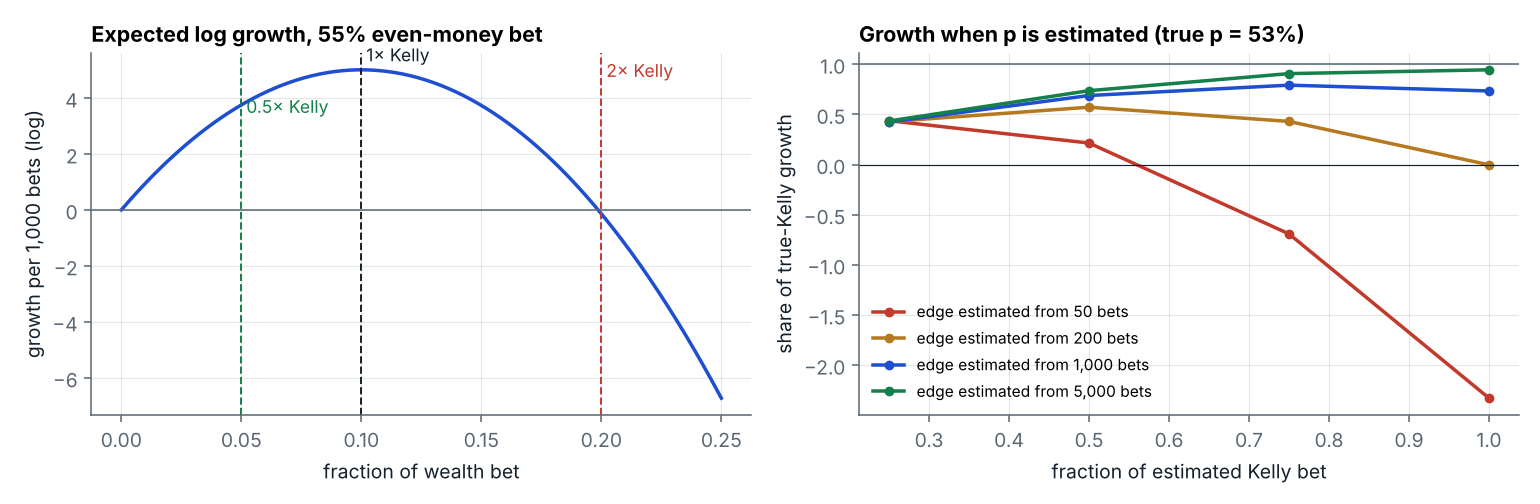
01Growth versus fraction
g(f) = p·ln(1 + b·f) + (1 − p)·ln(1 − f) f* = p − (1 − p)/b
02Two kinds of drawdown
| Fraction | f | Median wealth | P(end below start) | P(ever below ½ start): sim / theory | P(50% fall from a peak) |
|---|---|---|---|---|---|
| 0.25× | 0.025 | 8.92× | 0.3% | 0.6% / 0.8% | 9% |
| 0.5× | 0.050 | 42.63× | 0.9% | 11.3% / 12.5% | 86% |
| 1.0× | 0.100 | 149.66× | 6.0% | 47.4% / 50.0% | 100% |
| 1.5× | 0.150 | 41.91× | 21.4% | 74.8% / 79.4% | 100% |
| 2.0× | 0.200 | 0.87× | 51.2% | 90.4% / 100.0% | 100% |
My first check compared the simulated chance of a 50% drawdown with the closed form 0.52/c − 1 and found 86% against 12.5% at half Kelly. Neither was wrong: the closed form is the chance of ever halving from the starting stake, which the simulation reproduces (11.3%). The 86% is the chance of falling 50% from any peak over 1,000 bets, because every new high is a fresh chance. Both are now tested.
03Estimation error
With a true edge of 53% estimated from 200 past bets, full Kelly keeps -0% of the growth that perfect knowledge would give, and half Kelly keeps 57%. With only 50 past bets, full Kelly has negative expected growth. Overestimating the edge costs far more than underestimating it, which is why practitioners size at a fraction of Kelly.
04What I'd do next
- Multi-asset Kelly with correlated bets and leverage limits.
- Bayesian sizing that shrinks the estimated edge by its uncertainty.