01Design
- Prices are integer ticks, so there are no floating-point comparisons in matching.
- Each side is
dict[price → deque[Order]]plus a sorted list of active prices. Best bid and ask are O(1); a new level is a bisect insert. - Cancels are O(1) lazy deletes: the order is flagged dead and skipped when matching reaches it, and empty levels are cleaned from the top.
def _match(self, o, limit):
    while o.qty > 0:
        self._clean(opp)                       # drop dead orders at the top
        p = px[0] if o.side == "B" else px[-1]   # best opposite price
        if limit is not None and crosses_limit(p): break
        for m in queue_at(p):                # FIFO within the level
            n = min(o.qty, m.qty); o.qty -= n; m.qty -= n
            fills.append(Trade(o.oid, m.oid, p, n))
02Testing
- Priority: a buy for 8 against asks of 5 @ 100 and 5 + 5 @ 101 fills 5 @ 100 then the older 3 @ 101.
- Non-crossing orders rest; cancels are idempotent; market orders sweep levels.
- A 20,000-message random test asserts after every message that the book never crosses and traded volume never exceeds submitted volume.
03Benchmark
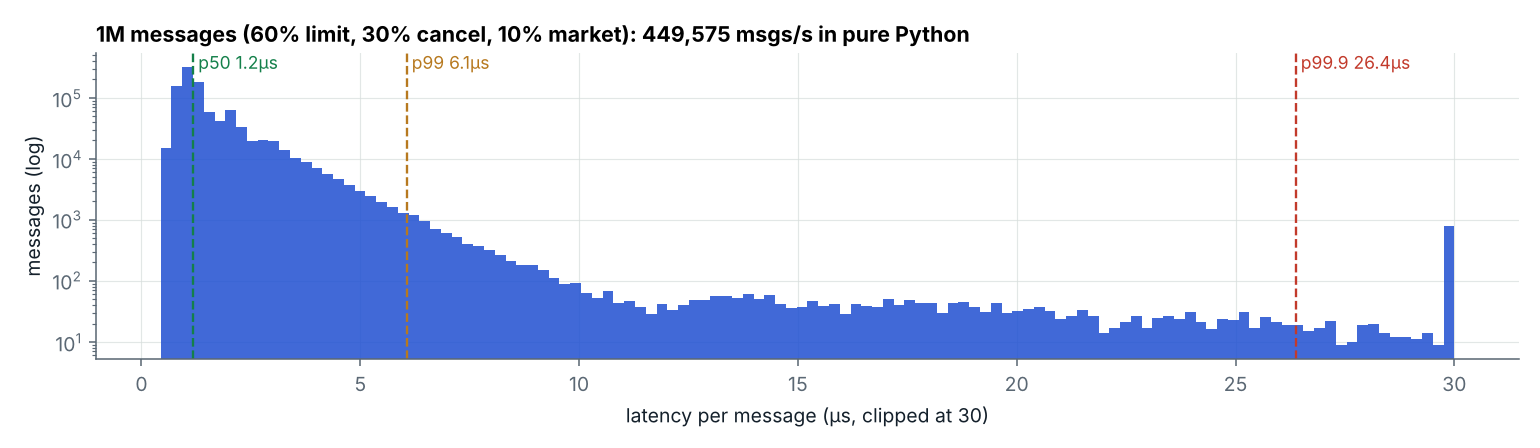
Pure Python is a deliberate baseline. Real engines run in C++ or Rust with preallocated memory and price-indexed arrays; that port is the next project, and this version becomes its correctness oracle.
04What I'd do next
- C++ port with intrusive linked lists and a price-indexed array; target over 10M messages/s.
- Replay an ITCH-style feed and reconstruct the book.