Oliver Scott
Secondary school student · planning a Mathematics / Computer Science degree
Expected university graduation 2031 · Brisbane
I'm a Brisbane school student who builds and tests quantitative ideas end to end: derivatives pricing, market making, matching engines, and an event-driven study of ASX junior miners now running as a live paper test.
Research note
One question followed all the way: hypothesis, data, validation, execution, and a live forward test.
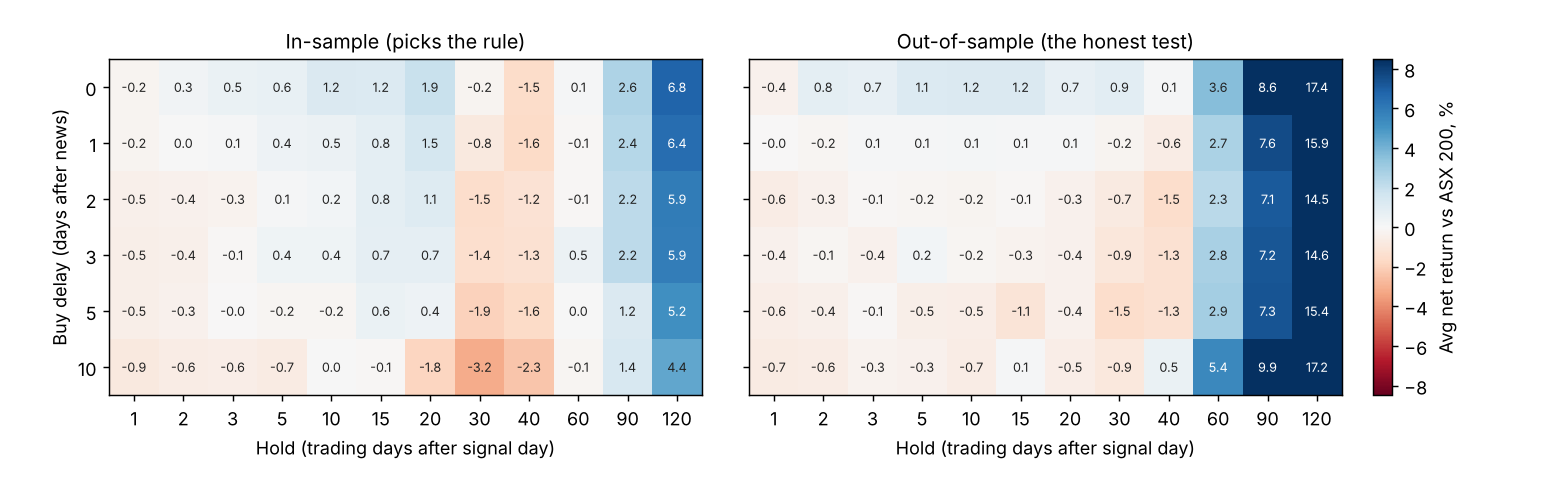
Do ASX junior miners keep moving after good news?
An event-study framework over ASX resource stocks: a 72-cell search over buy delay and hold length, chosen in-sample and judged out-of-sample, placebo tests, limit-order and stop-loss tests, and a cash-runway filter read from quarterly Appendix 5B reports.
Read the note →
Projects
Each has tested code, a reproducible figure script and a short write-up.
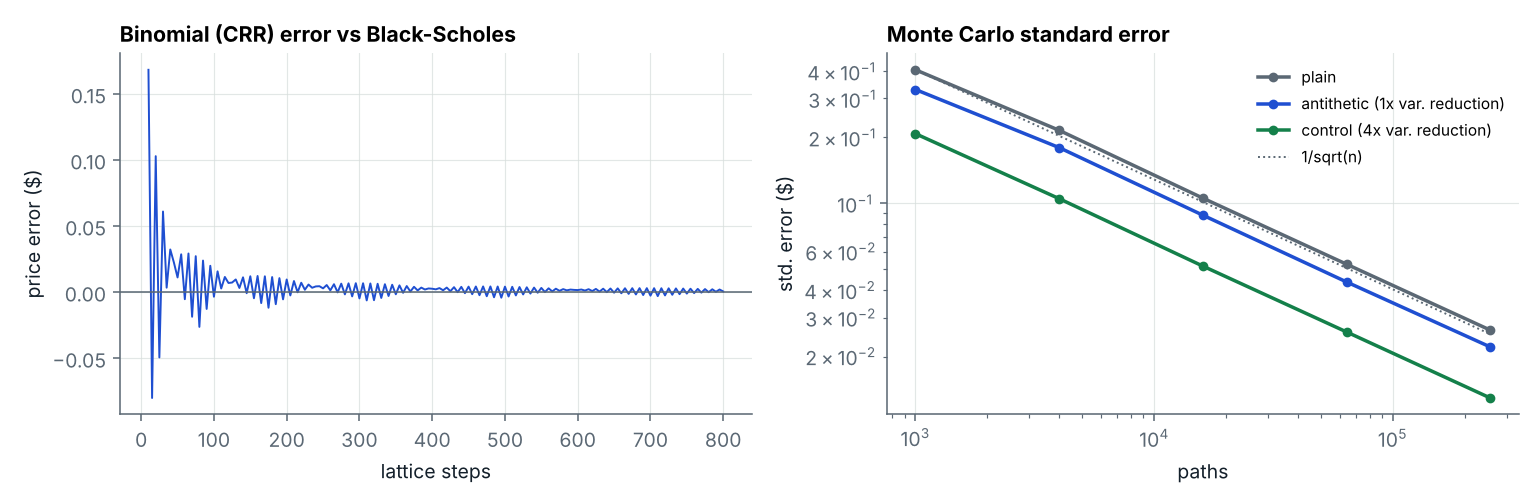
Options pricing and implied volatility
Black-Scholes, a CRR lattice with early exercise, Monte Carlo with variance reduction, analytic Greeks and a robust implied-vol solver.
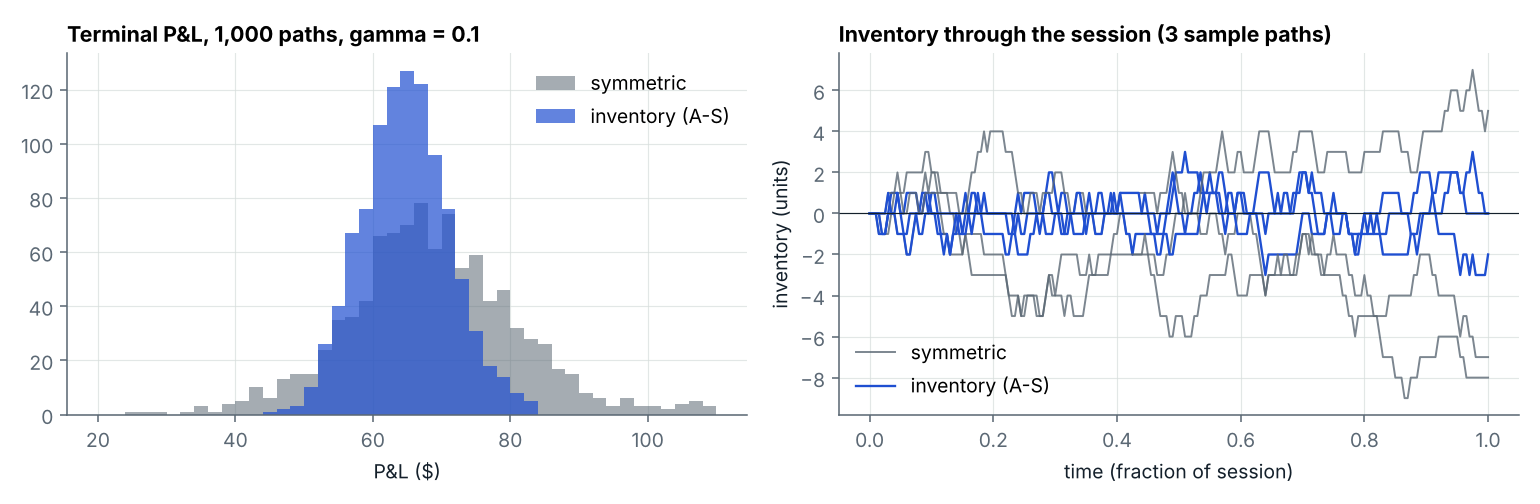
Market making under inventory risk
Avellaneda-Stoikov quoting against a symmetric benchmark: how skewing quotes by inventory trades a little mean P&L for half the risk.
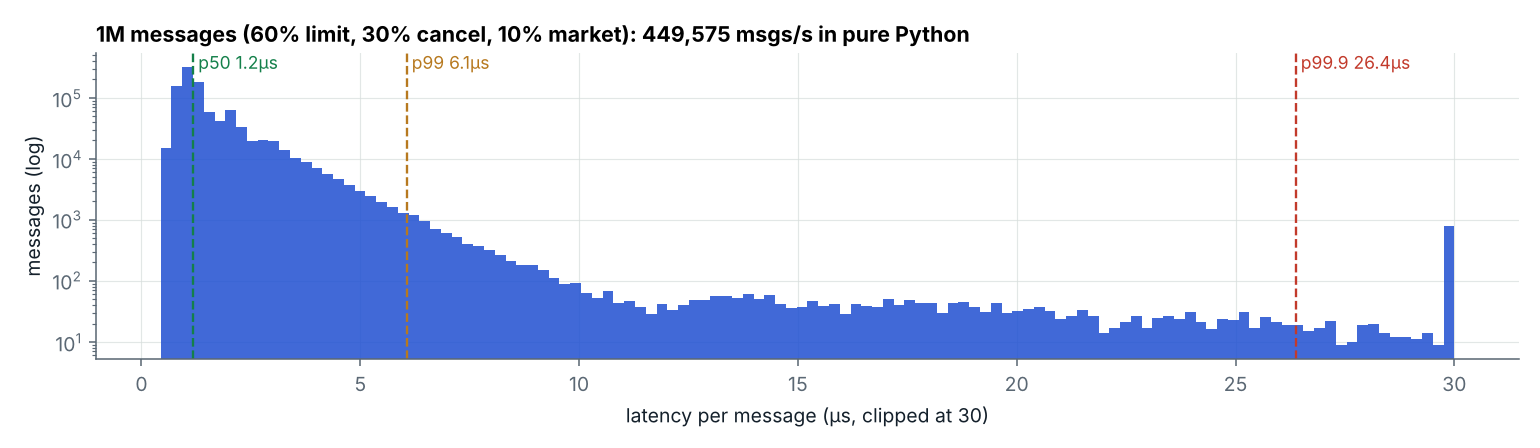
Limit order book matching engine
Price-time priority with limit, market and cancel messages, property-style tests, and a one-million-message latency benchmark.
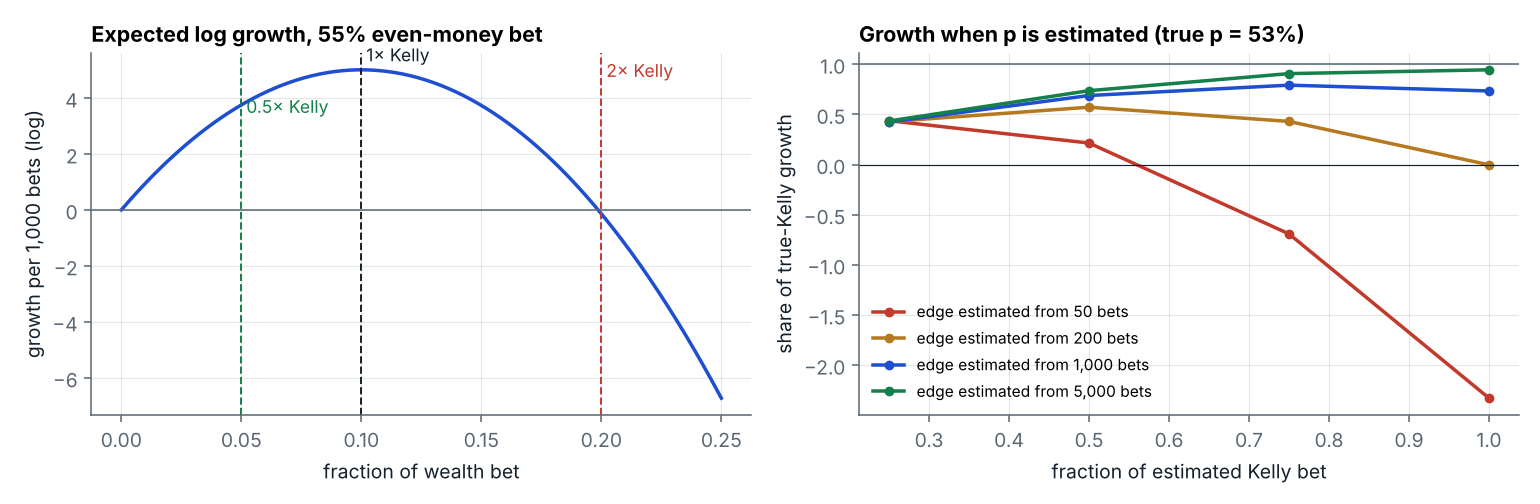
Bet sizing: Kelly and estimation error
Growth versus fraction bet, two kinds of drawdown, and why full Kelly on an estimated edge can earn nothing.
Pairs trading on ASX 200 constituents
Cointegration screening, Ornstein-Uhlenbeck half-lives, walk-forward selection and borrow costs.
Forecasting realised volatility
GARCH(1,1) vs HAR-RV vs a simple EWMA, scored with QLIKE on out-of-sample data.
C++ port of the matching engine
Intrusive lists and a price-indexed array, targeting over 10M messages/s, benchmarked against the Python version.
More than the projects
Where I'm heading next, how I practise, and the maths running live.
Twelve research proposals
Placement discounts, director buying, short interest, franking, closing auctions, Rio Tinto's London and Sydney lines, and more. Each has a hypothesis, data, method and pitfalls.
Interview problems, checked
Classic problems from HH versus HT to gambler's ruin, each solved exactly and then confirmed by simulation, with a live re-run button.
Option pricer and Kelly simulator
Move a slider and the price, Greeks and 2,000 simulated bettors recompute in your browser.
Skills, with evidence
Each skill links to where it's used. Levels are honest: proficient, working knowledge, learning.
Mathematics
- Probabilityproficient: notebook, Kelly
- Statistics & inferenceproficient: clustered t-tests, placebo tests
- Stochastic calculusworking: GBM, Black-Scholes, optimal quoting
- Numerical methodsworking: lattices, Monte Carlo, root finding
Programming
- Python (NumPy, pandas, SciPy)proficient: every project
- Testing (pytest)proficient: 33 tests across four public repos
- Performanceworking: latency benchmark, implied vol 2.7 ms → 81 µs
- C++learning: matching-engine port in progress
- JavaScriptworking: demos · Git, Linux, SQL basics
Markets
- Options & volatilityworking: pricing, Greeks, implied vol
- Microstructureworking: order books, market making, auctions
- Event studies & backtestingproficient: out-of-sample design, costs, biases
- ASX mechanicsworking: announcements, Appendix 5B, halts, auctions
How I test an idea
Signals use only data known at that close; trades enter the next day.
Choose on one period, judge on a later one, unchanged.
Random dates for the same stocks. If they do as well, it's noise.
Spread and impact scaled to liquidity; size capped by volume.
Simulations must match closed forms where they exist.
Live forward test before any capital.
How I built this
I use AI coding assistants the way I'd use a strong colleague: to draft code, suggest tests and review my reasoning. Every result here was run, checked against theory or an independent method, and is reproducible from a script in the repo.
Where I found and fixed problems, the write-ups say so: the implied-vol edge cases, the Kelly drawdown mix-up, the ranking rule that drifted to 120-day holds.
- Question first. I write the hypothesis and what would disprove it before any code.
- Test against truth. Closed forms, textbook values, planted effects and shuffled data.
- Rebuild to understand. I re-implement core pieces from a blank file and extend each project in my own direction.
- Show the limits. Every page lists what could make the result wrong.